


The numbers first
- Healthy skin sits at pH 4.5 to 5.5. Baking soda dissolved in water lands around 8.3, and that mismatch is linked to underarm burning.
- Magnesium hydroxide is also alkaline, but it's only slightly water-soluble, so it releases into sweat gradually instead of all at once.
- Packaging format has no demonstrated effect on irritation. Glass bottles cut plastic waste; the formula decides how your skin reacts.
- Refill pouches cost $19 and last roughly 1 to 2 months each. Subscriptions run $15.75 a month versus $21.00 for a one-time purchase.
What actually separates gentle from stinging
Most sensitive underarms don't react to the container. They react to what's inside it. So why does one natural deodorant leave you comfortable while another has you wincing by Thursday? Three things: pH behavior, ingredient load, and fragrance exposure. Glass versus plastic barely registers next to those.
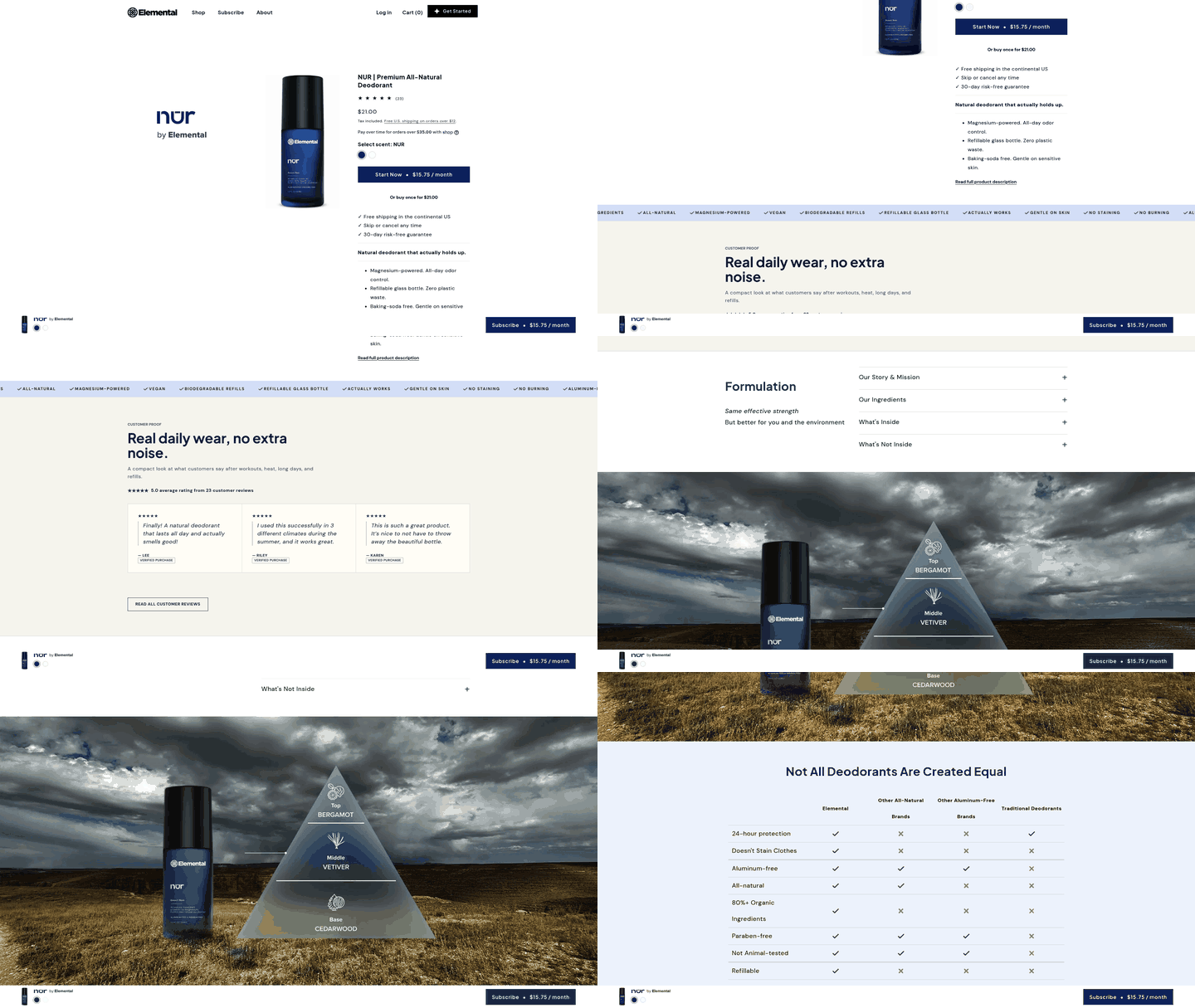
Baking soda can feel harsh because it moves into sweat quickly and shifts the skin environment fast. Magnesium hydroxide takes the slow road. That's why it often makes more sense if you've felt burning from a traditional natural stick. The glass bottle is a waste decision, and a good one, but it's not what makes the formula feel gentler.
| Option | Main irritation risk | How it handles odor | Format | Function |
|---|---|---|---|---|
| Our 30 ml refillable glass-bottle magnesium formula | No baking soda, aluminum, or synthetic fragrance; scents use essential oils | Magnesium hydroxide dissolves slowly in sweat | Glass bottle plus refill pouches | Deodorant: odor only |
| Baking-soda natural deodorants | Strongly alkaline against acidic skin | Dissolves readily in sweat | Varies | Deodorant |
| Fragrance or essential-oil-heavy formulas | Fragrance is a common allergy trigger | Masks odor | Varies | Deodorant |
| Extra or clinical-strength antiperspirants | Higher aluminum concentrations flagged for sensitive skin | Aluminum salts plug sweat glands | Varies | Antiperspirant: blocks sweat |
Which option fits your skin?
If baking soda burned you, a magnesium formula is the logical next step. If you need to stop wetness, not just odor, no deodorant will get you there. A regular-strength antiperspirant is the usual dermatologist-backed pick for that job. And if you've had a confirmed fragrance allergy, treat our essential-oil scents with caution.
What does switching cost?
The bottle is a one-time buy. Refills are the ongoing part. The savings come from keeping the same container instead of replacing a full stick or bottle every time you run out. In our experience, the refill route costs less over a year than repurchasing premium natural sticks, especially for daily users who already know the formula agrees with them.
Who gets the most out of a magnesium formula
Three groups, mostly.
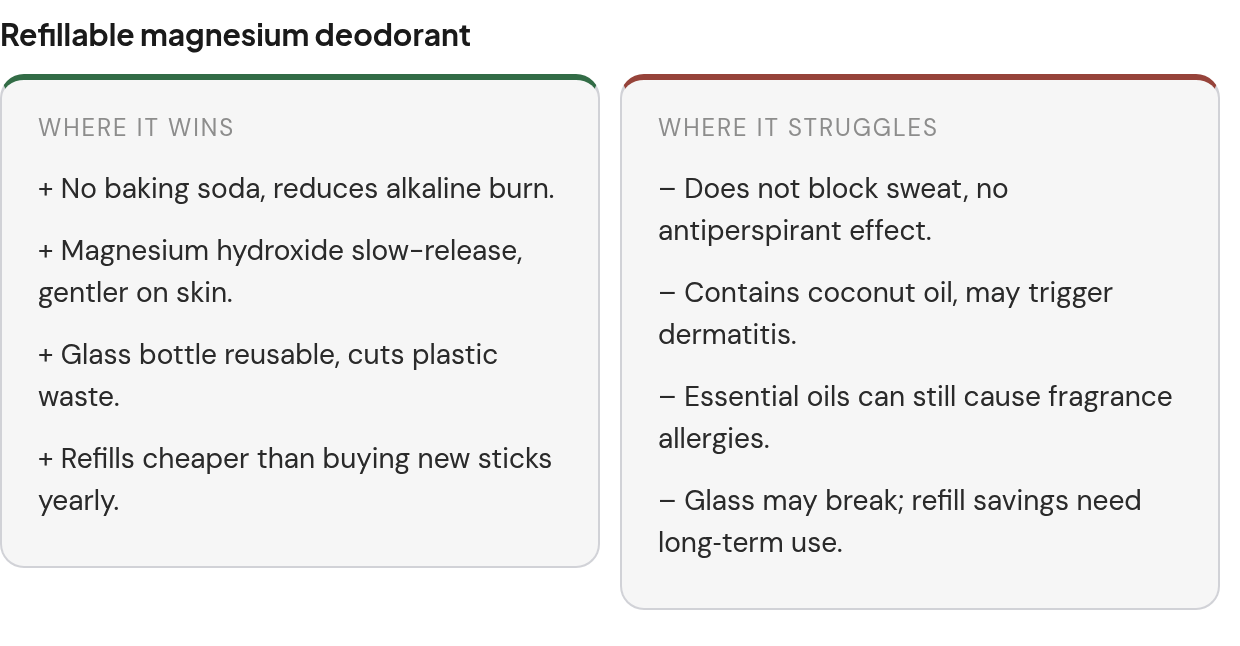
First, people who tried a baking-soda deodorant once, felt the sting within a week, and wrote off the whole category. Second, anyone with diagnosed contact dermatitis or a history of fragrance reactions who wants the shortest ingredient list they can find. Third, fitness users applying twice a day. Layering applications is where harsher formulas tend to pile up irritation, and you don't want that building under a sports bra or a compression shirt.
Fragrance is a common trigger for deodorant reactions. Essential oils get marketed as the gentle alternative, but they can still cause contact dermatitis in some people, and individual tolerance varies. "Natural" isn't a synonym for "non-reactive." If you've reacted to a natural deodorant before, start unscented and add fragrance only after a clean two-week trial. Our scents are made from essential oils, and the formula is built to be sensitive-skin friendly and avoid common irritants. Your skin's history still gets a vote.
Patch-testing matters more than format. Apply a small amount to your inner forearm, wait 24 to 48 hours, and watch for redness or itch before you move to your underarms. The best natural deodorant for sensitive skin is the one that passes your own patch test, not the one with the prettiest package.
Once a formula passes, refillable packaging earns its keep. Our magnesium-powered formula uses magnesium as a natural deodorizer for all-day protection and skips aluminum, parabens, and phthalates. The glass bottle refills from biodegradable pouches, which means you stay on a formula you already trust instead of gambling on a new product every restock.
Pros and cons, without the sales gloss
Natural deodorants for sensitive skin tend to fail for predictable reasons. The ones that work usually do two things: they avoid the common irritants, and they make daily reapplication feel boring instead of risky. Boring is the goal.
What the refillable magnesium format gets right
Pairing a refillable bottle with a magnesium-hydroxide formula addresses two big underarm complaints: the sharp feel some people get from baking soda, and the uncertainty around added scent. We skip baking soda and synthetic fragrance and use magnesium hydroxide instead. That swap matters most if you want odor control without retreating to a conventional antiperspirant.
On the packaging side, the glass bottle is meant to stay in use indefinitely. If it ever breaks, glass can be recycled repeatedly without losing quality. The refill pouches are thin and flexible, so they use less material than a rigid stick and take up less room in shipping and in your trash.
Try a natural deodorant that actually works
Experience 24-hour odor protection with Elemental Deodorant. Made with organic ingredients, it's aluminum-free, vegan, and eco-friendly. Gentle on your skin and the planet.
Shop Elemental| Feature | Elemental Refillable | Typical Baking-Soda Stick | Aluminum Antiperspirant |
|---|---|---|---|
| Main active | Magnesium hydroxide | Sodium bicarbonate | Aluminum salts |
| pH approach | Alkaline, slow-release | Alkaline, fast-dissolving | Acidic to neutral |
| Fragrance | None (unscented option) | Often essential oils | Synthetic or none |
| Format | Glass bottle + pouches | Single-use plastic tube | Plastic stick |
| Function | Odor control | Odor control | Sweat + odor blocking |
Where individual tolerance still applies
No natural deodorant is universally tolerated. Ours included. The formula contains coconut oil and organic witch hazel, and either can trigger reactions in some users. How fast a reaction shows up, and how long it sticks around, varies from person to person. If irritation appears, stop using the product.
The other trade-off is function. Antiperspirants physically clog sweat glands with aluminum. We don't, so you'll still perspire.
Who should buy it, and who shouldn't
Start with the filter: no aluminum means no sweat-blocking. If you need dry underarms for a presentation or a race, this isn't your product. That rules out more people than you'd expect, and we'd rather say so up front than field the return.
For everyone else hunting for the best natural deodorant for sensitive skin, start with what you want to avoid. Our lower-irritation case rests on the formula: magnesium hydroxide instead of baking soda, no synthetic fragrance, no aluminum. The 30 ml refillable glass bottle is about waste, not skin.
| Option | Best fit for | Skip it if |
|---|---|---|
| Our magnesium formula, refillable glass | Odor control without baking soda or synthetic fragrance; you want a keep-forever bottle | You need sweat reduction, or you react to coconut oil or any listed ingredient |
| Regular-strength antiperspirant | You need dryness; aluminum-based formulas can reduce wetness | Your skin flares under "extra strength" or "clinical strength" labels |
| Baking-soda natural stick | Normal skin that tolerates alkaline formulas | You've felt burning from natural deodorant before |
Patch testing settles what labels can't
Even a gentler formula can irritate with heavy, repeated use. Leftover grit from mineral powders and starches can chafe, too. Try it on a small area before committing to daily underarm use.
If it burns, stop. Don't sit through a mythical "adjustment period." Nobody has actually measured one.
A clean patch test also tells you something a clinic result alone can't. The standard T.R.U.E. Panel can miss uncommon fragrances, so your own skin is the better judge of this specific product.
The refill math rewards commitment
Refills only pay off if the formula already suits you and you plan to keep the bottle. So pass the skin test first. Then watch your first bottle: if you're using it most days and reaching for it without thinking, refills make sense. The glass survives years of normal use, so your second and third pouches skip the packaging waste of buying new. Run the numbers on refills versus a new bottle to see when the system pays for itself.
Your first two weeks with a magnesium deodorant
Glass won't save a reactive armpit. Nothing we found shows the bottle itself calms skin, and we'd rather you hear that from us than from a rash. Read the ingredient list first. Look at the container second.
What earns our formula a spot on a sensitive-skin shortlist is subtraction: it drops baking soda, synthetic fragrance, and aluminum in one go, with magnesium hydroxide handling odor in their place. Here's how that maps to your priorities.
| Your priority | Our recommendation |
|---|---|
| Refillable, no baking soda, no synthetic fragrance, no aluminum | Our magnesium formula in refillable glass |
| Dry underarms and real sweat reduction | A regular-strength antiperspirant, skipping "clinical strength" labels |
| You react to coconut oil, witch hazel, or another listed ingredient | A formula without that ingredient |
| Active rash or dermatitis | Nothing new until your skin settles |
When should you pick something else?
Magnesium isn't a free pass. Some people still react to magnesium deodorants, especially when they apply a lot. Texture plays a part as well: powders and starches that sit on the skin can rub every time your arms move. And some dermatologists flag coconut oil as a trigger. Check the full list before you buy: water, organic witch hazel, magnesium hydroxide, arrowroot powder, coconut oil, glycerin, tocopherol, lecithin, and xanthan gum.
Time your first real application. Not right after shaving, when tiny nicks make almost any formula sting. If you see redness or itching, stop. Your skin has answered the question.
A clean first trial isn't a lifetime guarantee, either. If a reaction shows up weeks later, take it seriously instead of assuming the product's fine because it worked at first. If you pass and the ingredient list suits you, our guide to how refillable deodorant works covers the rest of the system.
Common Questions
1. Can I apply a magnesium deodorant right after shaving?
Wait before applying. Freshly shaved skin is more vulnerable, and even a well-tolerated formula can feel sharp on compromised skin. Give your underarms a chance to calm down before judging whether the deodorant agrees with you.
2. Is there a detox or adjustment period when switching to natural deodorant?
No one has proven a universal detox phase for deodorant. Burning, redness, or itch is better treated as useful feedback from your skin, not as a challenge to push through. The fix is usually a different formula or a simpler routine.
3. Are essential oils gentler than synthetic fragrance for sensitive underarms?
Not automatically. Plant-derived scent can still bother sensitive skin, especially for people with a history of fragrance reactions. Elemental's scented versions use essential oils, so the unscented option is the cleaner starting point if your underarms are reactive.
4. If my dermatologist's patch test came back clear, do I still need to test a new deodorant?
Yes. A clinic panel is helpful, but it doesn't test every possible ingredient blend in every product you might buy. Trying the actual deodorant on your own skin gives you product-specific information, and any later reaction still matters.
5. What if I'm sensitive to coconut oil or witch hazel?
Choose a formula without that ingredient. Elemental's magnesium deodorant contains both coconut oil and organic witch hazel. Dropping baking soda and synthetic fragrance won't help if your skin reacts to something else on the label. Read the full ingredient list before buying.