


Plastic waste is a growing problem, with 400 million metric tons produced annually and only 18% recycled. Deodorant packaging is a significant contributor, often relying on long-lasting petroleum-based plastics like PET and HDPE that can take centuries to decompose. Biodegradable refills offer a faster alternative, breaking down within 90 days under industrial composting conditions. However, their success depends on proper disposal, as limited access to composting facilities often leads to these materials ending up in landfills, behaving similarly to conventional plastics.
Key Points:
- Biodegradable refills use plant-based materials like PLA and PHA.
- Industrial composting (58°C) enables 75%-100% breakdown in 90 days.
- Conventional plastics persist for decades, with less than 7% breaking down in marine environments over 28 days.
- Biodegradable options may leave trace microplastics if conditions are suboptimal.
- Refillable systems, like glass bottles paired with biodegradable pouches, reduce waste but require consumer effort and proper infrastructure.
Takeaway: While biodegradable refills reduce waste faster than plastics, their impact depends on access to composting facilities and responsible disposal practices. Pairing them with reusable containers, like Elemental Deodorant’s glass bottles, offers a more effective solution for reducing packaging waste.
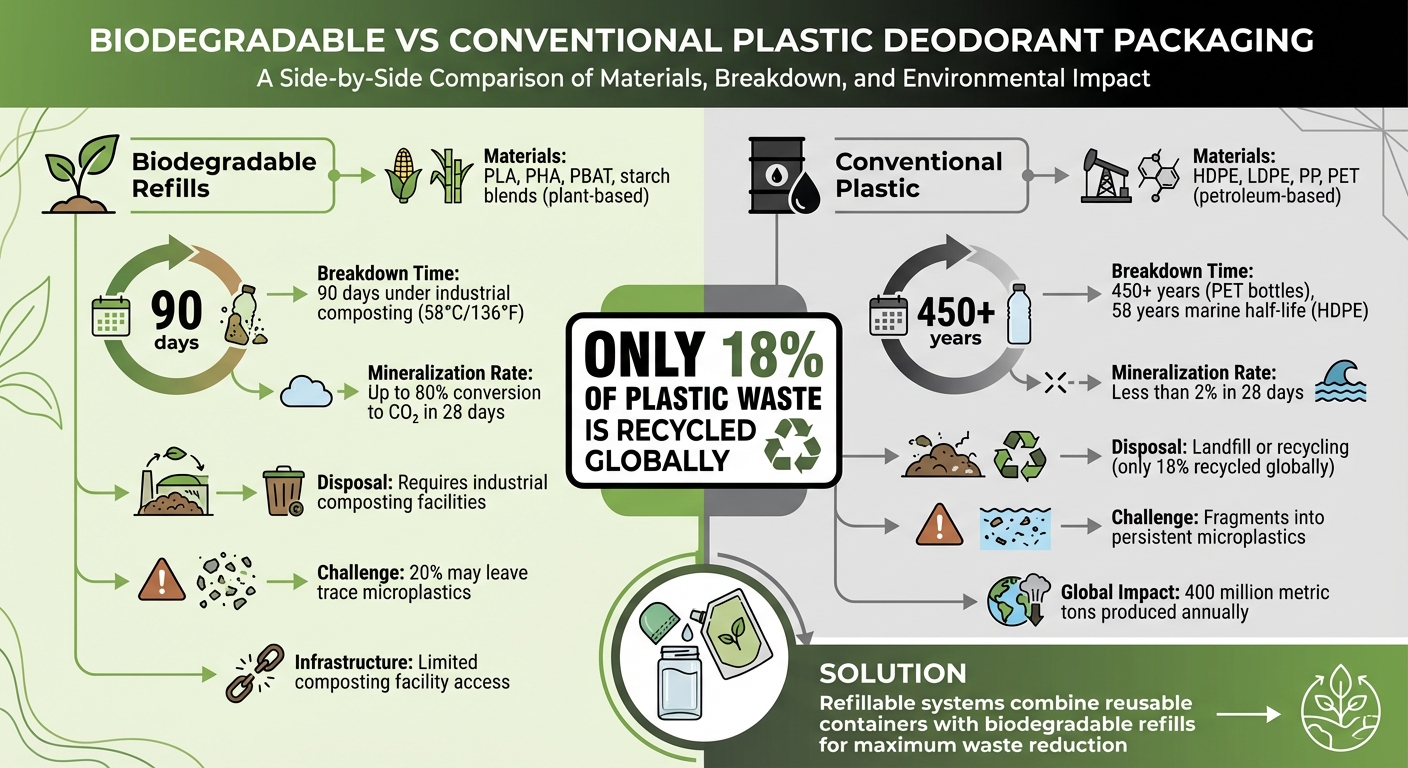
Biodegradable vs Conventional Plastic Deodorant Packaging Breakdown Comparison
1. Biodegradable Refills for Natural Deodorant
Material Composition
Biodegradable refills for natural deodorant rely on plant-based materials instead of traditional petroleum-derived plastics. Commonly used materials include Polylactic Acid (PLA), made from cornstarch; Polyhydroxyalkanoates (PHA), created through microbial fermentation; and paper-based composites. Some brands take it a step further, using a mix of 99.98% FSC-certified paper and a thin 0.02% PLA layer to provide a moisture-resistant barrier while ensuring biodegradability [4].
Unlike conventional deodorant containers, which often use fossil-fuel-based plastics like LDPE or PP, these biodegradable alternatives are designed to break down through microbial activity, exposure to light, and hydrolysis [2].
Decomposition Time
Under industrial composting conditions - where temperatures reach around 58°C - most biodegradable products break down significantly, with 75% to 100% disintegration typically achieved within 90 days [3]. For example, rigid PLA components like lids or containers may fragment in as little as 14 to 30 days. Flexible materials, such as PBAT/starch blends used in refill pouches, show more variation; some fully disintegrate by day 59, while others may still be partially intact after 90 days [3].
In marine environments, P3HB - a type of bioplastic - has been shown to mineralize up to 80% into CO₂ within 28 days, a stark contrast to the less than 7% mineralization observed with traditional plastics like PET and polystyrene [2]. These differences highlight how decomposition rates can vary widely based on the material and environmental conditions.
Environmental Impact
While biodegradable refills offer environmental advantages, they are not without challenges. Research indicates that 20% of biodegradable products can leave behind trace amounts of microplastics after 90 days [3]. This incomplete breakdown often results from less-than-ideal environmental conditions, such as insufficient microbial activity or temperature.
"Many consumers and businesses are genuinely trying to do the right thing... but unfortunately they're often replacing one harmful material with another."
– Judith Enck, President, Beyond Plastics [5]
Another concern lies in the additives used in bioplastics. These chemical additives may have environmental effects that are not yet fully understood [5]. Additionally, the absence of federal standards in the U.S. for terms like "biodegradable" can lead to confusion, making it harder for consumers to make informed choices. Addressing these issues calls for advancements in materials and better disposal practices.
End-of-Life Pathways
Proper disposal is crucial to realizing the environmental benefits of biodegradable refills. Aerobic industrial composting - where high temperatures of around 58°C and controlled moisture levels accelerate decomposition - is the most effective method [3][7]. Some products, labeled "OK compost home", can also decompose in residential compost bins, though the process is slower and less consistent due to lower temperatures.
It's important to note that compostable plastics should never be placed in recycling bins, as they can contaminate the recycling stream [8]. For those using refillable systems, such as Elemental Deodorant's glass bottles with biodegradable refill pouches, the benefits extend beyond sustainability. These systems not only reduce waste but also offer a 40% savings on subscription costs [1]. Access to proper composting facilities - whether industrial or home-based - is essential for completing the decomposition cycle and maximizing the environmental benefits of these products.
2. Conventional Plastic Deodorant Packaging
Material Composition
Unlike biodegradable refills that break down quickly, conventional plastic packaging tells a very different story. Most deodorant containers are crafted from petroleum-based plastics such as high-density polyethylene (HDPE), low-density polyethylene (LDPE), polypropylene (PP), and polyethylene terephthalate (PET). These materials are derived from nonrenewable resources like crude oil, natural gas, and coal[9]. Designed for durability, these plastics are manufactured using processes like injection molding, extrusion, or blow molding. To further extend their lifespan, they are often enhanced with stabilizers and antioxidants. Their high molecular weight and water-repellent properties make them resistant to light, water, and microbial breakdown[9]. While these features make them effective for packaging, they also mean they stick around for a very long time.
Decomposition Time
Conventional plastics are designed to last, and that durability comes at an environmental cost. For instance, PET bottles can take around 450 years to decompose, while HDPE deodorant containers have a marine half-life of approximately 58 years[12, 14]. In landfills, where conditions limit sunlight and oxygen, these plastics can remain intact indefinitely. Compounding this issue, the world produces nearly 400 million tons of plastic waste annually, yet only about 18% of it gets recycled[9].
Environmental Impact
In the United States, over 75% of discarded plastics end up in landfills, and plastics make up about 19% of all municipal solid waste. The problem doesn’t stop there - plastic waste in the oceans is projected to grow from 50 million tons in 2015 to 150 million tons by 2025[9].
"The very properties that make plastics so versatile for humans has also created an emerging threat to the environment." – ACS Sustainable Chemistry & Engineering[9]
Ocean plastics don’t just float harmlessly - they carry toxic substances like polychlorinated biphenyls (PCBs), pesticides, and polycyclic aromatic hydrocarbons (PAHs). These pollutants can accumulate in marine life and eventually make their way up the food chain. Unlike biodegradable materials, conventional plastics don’t break down entirely. Instead, they fragment into microplastics, which persist in soils, waterways, and oceans for generations, creating ongoing environmental challenges.
End-of-Life Pathways
Globally, only 18% of plastic waste is recycled, with the rest either incinerated or sent to landfills[9]. The Federal Trade Commission warns against labeling items as "degradable" unless they fully decompose within one year of disposal[8]. While many plastic deodorant containers are technically recyclable, the reality is that recycling rates are disappointingly low. Without widespread recycling infrastructure and active consumer participation, the majority of these containers end up in landfills, where they either remain for centuries or break down into microplastics that infiltrate ecosystems around the globe.
How Long Does It Take for Biodegradable Packaging to Decompose? - Ecosystem Essentials
sbb-itb-18dae44
Pros and Cons
Understanding the trade-offs between biodegradable refills and conventional plastic packaging helps in making informed decisions. Here's a comparison of how these two packaging options stack up across key factors:
| Factor | Biodegradable Refills | Conventional Plastic Packaging |
|---|---|---|
| Breakdown Time | 90 days to 1 year under industrial composting conditions (typically around 58°C/136°F)[3][8] | Tens to hundreds of years in natural environments[8] |
| Primary Materials | PLA, PHA, PBAT, or starch blends derived from plant sources[3] | LDPE, PP, PET, or PS made from petroleum[2] |
| Mineralization Rate | Up to 80% conversion to CO₂ within 28 days (for P3HB biopolymer)[2] | Less than 2% mineralization over 28 days[2] |
| Disposal Requirements | Requires industrial composting facilities (typically around 58°C/136°F)[3][8] | Disposed of through conventional recycling or landfill processes[8] |
| Environmental Impact | May generate microplastics during breakdown; 20% of tested products showed contamination in compost[6] | Persistent in the environment and prone to fragmenting into microplastics[8] |
| Infrastructure Challenges | Limited access to industrial composting in many U.S. communities; can contaminate plastic recycling streams if mixed[5][8] | Low recycling rates; small components like caps can clog recycling machinery[8] |
This comparison underscores the practical challenges and environmental considerations associated with each option, paving the way for more sustainable systems like Elemental Deodorant's refillable model.
Biodegradable refills can fully break down within 90 days under industrial composting conditions[3], but access to such facilities is limited. Judith Enck, President of Beyond Plastics, highlights this issue:
"Compostable plastics can only break apart in a commercial composting facility, and few communities in the U.S. have access to commercial composting facilities"[5].
Without access to these facilities, biodegradable refills often end up in landfills, where they behave much like conventional plastics.
On the other hand, conventional plastics benefit from existing recycling systems, but their long-term environmental impact remains problematic due to low recycling rates and their tendency to persist in the environment. The Federal Trade Commission has emphasized this concern, stating:
"it is deceptive to make an unqualified degradable claim for items entering the solid waste stream if the items do not completely decompose within one year after customary disposal"[8].
This standard is one that conventional plastics fail to meet, given their extended degradation timelines.
Elemental Deodorant offers a practical solution by combining biodegradable refills with reusable glass bottles. When industrial composting is available, the biodegradable refills break down efficiently, while the glass bottles are designed for repeated use. This dual approach addresses both the need for rapid breakdown and the challenges posed by limited composting infrastructure.
Conclusion
Biodegradable refills, when exposed to industrial composting conditions at 136°F, break down into CO₂, water, and biomass within 90 days to six months[3][8]. In stark contrast, conventional petroleum-based plastics can linger in the environment for decades - or even centuries[8]. However, the effectiveness of biodegradable packaging hinges on access to proper composting facilities, which remain scarce in many parts of the United States. This highlights the importance of informed consumer choices.
For those looking to make environmentally conscious decisions, it’s essential to go beyond simply opting for biodegradable products. Look for certifications like EN 13432 for industrial compostability or "OK compost home" for backyard composting[3]. Additionally, reach out to local waste management services to locate compost drop-off sites in your area.
A more impactful solution combines biodegradable materials with refillable systems to significantly reduce packaging waste. Elemental Deodorant has embraced this approach with its permanent glass bottle and biodegradable refill pouches, designed to be emptied directly into the glass container[1]. This "keep the bottle" system addresses both the challenge of material decomposition and the lack of composting infrastructure, presenting a practical zero-waste alternative. By integrating these strategies, it’s possible to reduce waste while making a meaningful environmental impact.
FAQs
What makes biodegradable deodorant refills better for the environment than plastic containers?
Biodegradable deodorant refills offer a thoughtful alternative to traditional plastic containers, which can linger in landfills for centuries. Unlike conventional plastics that contribute to long-lasting pollution, these refills are designed to break down more quickly and can even return to the earth as compost when disposed of under suitable conditions.
That said, the positive impact of these refills depends heavily on proper disposal practices and advancements in bioplastic standards. Opting for biodegradable options, such as those from Elemental Deodorant, is a meaningful way to cut down on waste while embracing packaging solutions that align with a cleaner, greener future.
What challenges do biodegradable refills face without access to industrial composting?
Biodegradable refills require specific conditions to break down properly - temperatures of at least 131°F, sufficient moisture, oxygen, and the presence of active microbes. These conditions are generally found in industrial composting facilities. In contrast, home compost bins or landfills often lack the necessary warmth and moisture, causing the material to degrade at a much slower rate or not at all. In such cases, it can end up behaving much like traditional plastic waste.
For users of Elemental Deodorant, this means the biodegradable refill fulfills its environmentally friendly purpose only when processed through a certified industrial composting program. Without access to these facilities, the refill may linger in landfills, diminishing its intended ecological benefit. To make the most of its design, it’s essential to explore local composting programs and carefully follow any disposal instructions provided to prevent unnecessary waste.
Do biodegradable deodorant refills create microplastics, and how can this be avoided?
When using biodegradable deodorant refills, there's a risk they might break down into microplastics if they don't decompose completely. To avoid this, look for refills made from certified industrial-compostable materials and ensure they are disposed of in proper composting systems that maintain the necessary temperature and moisture levels. For those with home compost setups, certified options can also work well when managed correctly.
Opting for well-made biodegradable refills that fully break down without leaving harmful residues can significantly reduce microplastic pollution, contributing to a cleaner environment and a more responsible way of living.
Related Blog Posts
- Natural vs Chemical Deodorants: Understanding the Differences
- Essential Oils in Natural Deodorant: Benefits and Effects
- Why Does Natural Deodorant Cost More? A Complete Breakdown
- Magnesium in Deodorant: Benefits for Skin
Ready to try a natural deodorant that actually works?
See how the system works: refillable natural deodorant — a glass bottle you keep, biodegradable pouches that refill it.