


You want deodorant that controls odor without leaving your underarms itchy or uncomfortable. If you’re comparing magnesium vs baking soda deodorant, I’d start with what your skin has tolerated - not which ingredient gets more attention.
Baking soda may work well for you. If it has caused irritation, a baking-soda-free magnesium formula may be worth trying. Neither ingredient tells the whole story: fragrance, texture, and the rest of the formula matter too.
I’ll walk you through what to compare, when to consider a fragrance-free option, and how to test before buying refills. The goal is simple: <u>choose for odor control and skin comfort</u>, without guessing from the label alone.
H2: How Magnesium Deodorant Works
Magnesium deodorant controls odor, not sweat. You may still notice dampness because it doesn’t stop sweating. Magnesium and baking soda also differ in how they interact with underarm skin.
Magnesium hydroxide dissolves slowly in water and sweat. Baking soda dissolves more readily. That difference can affect skin feel, but it doesn’t guarantee comfort.
Look at the full formula, not just the label. The compound, its concentration, and the base ingredients all shape odor control and how the deodorant feels on your skin.
If you want to avoid baking soda, review Air fragrance-free’s current ingredient list to check whether it fits that preference. Compare the formula with your skin history, especially if you need odor control without irritation. It may suit sensitive skin, but results vary.
sbb-itb-18dae44
How Baking Soda Controls Odor and May Irritate Skin
Baking soda, or sodium bicarbonate, can reduce odor but leave your underarms uncomfortable. It neutralizes odor, while its alkalinity can disrupt your skin’s acidic surface.[2]
Stop using any formula that causes dryness, stinging, redness, itching, or a rash. Avoid applying it right after shaving or to already irritated skin. Reactions can develop even after weeks of use.[2] A reaction doesn’t always mean an allergy: repeated exposure may irritate skin, and fragrance or essential oils may also be the trigger.[2]
If baking soda keeps irritating your underarms, consider a magnesium formula, which increases pH more gradually.[2] Compare odor control and skin comfort when choosing a baking-soda-free deodorant. If you also want a fragrance-free option, check the current details for Air from Elemental.
Magnesium vs Baking Soda: What to Compare
Compare odor control, skin feel, and residue - not just the mineral. Magnesium hydroxide and baking soda can both neutralize odor, but neither guarantees results. Your skin chemistry and the rest of the formula affect how well a deodorant works for you.[2]
Use these differences to help choose a formula that fits your skin.
| What to compare | Baking soda deodorant | Magnesium hydroxide deodorant |
|---|---|---|
| Odor-control approach | Neutralizes odor by changing underarm conditions to inhibit bacteria.[1] | Neutralizes odor-causing acids.[1][4] |
| Alkalinity and skin pH | Highly alkaline and can upset skin balance.[3] | Also alkaline, but its low solubility may make it feel gentler on skin.[3][1] |
| Sensitive skin | Can sting or irritate sensitive skin.[3] | May suit sensitive skin better, though no formula guarantees irritation-free use.[1][3] |
| If baking soda has irritated you before | May not be the best fit for your skin. | Consider a baking-soda-free formula and check for other possible triggers. |
| Other formula ingredients | Oils, waxes, and starches affect glide, moisture absorption, skin feel, and residue.[1] | Texture and residue depend on the full formula, not magnesium alone.[1] |
The base formula matters as much as the active ingredient. When choosing a baking-soda-free deodorant, check the rest of the formula too - not just whether it uses magnesium.
How to Choose and Test a Deodorant
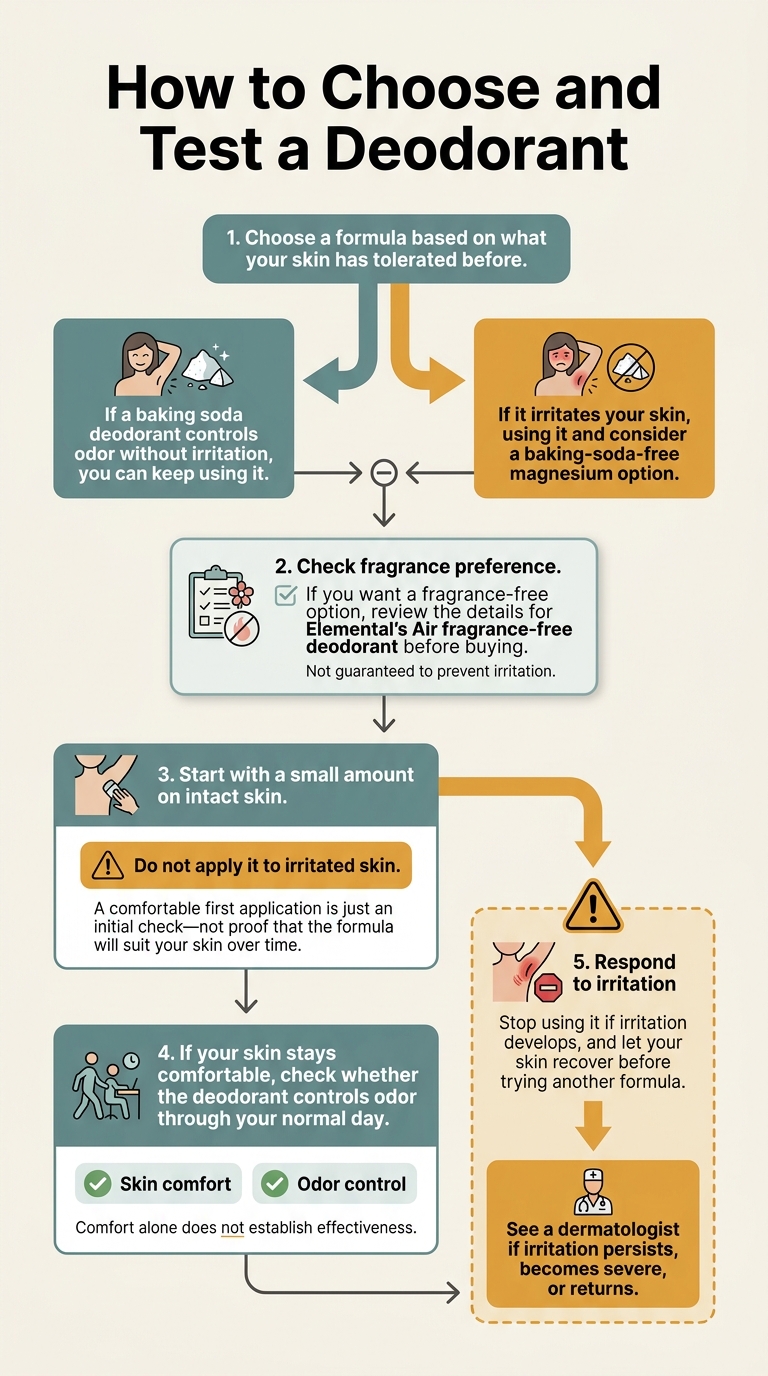
How to Choose and Test a Deodorant
Choose a formula based on what your skin has tolerated before. If a baking soda deodorant controls odor without irritation, you can keep using it. If it irritates your skin, stop using it and consider a baking-soda-free magnesium option.
If you want a fragrance-free option, review the details for Elemental’s Air fragrance-free deodorant before buying.
Start with a small amount on intact skin. Do not apply it to irritated skin. A comfortable first application is just an initial check - not proof that the formula will suit your skin over time.
If your skin stays comfortable, check whether the deodorant controls odor through your normal day.
Stop using it if irritation develops, and let your skin recover before trying another formula. See a dermatologist if irritation persists, becomes severe, or returns.
Choosing an Elemental Deodorant Option
Once you’ve compared odor control and skin comfort, narrow your Elemental choice by scent, refill format, and customer reviews.
If baking soda irritates your underarms, an aluminum-free, baking-soda-free magnesium deodorant avoids that trigger. Check Elemental’s current product details before buying, and choose by skin tolerance and scent preference, not the magnesium label alone.
NUR Scented or Air Fragrance-Free
Consider NUR scented if you want fragrance and have tolerated scented deodorants. Consider Air fragrance-free if you prefer no fragrance or have reacted to scented formulas. Confirm each option’s current details on its product page.
| Option | When to consider it | Where to buy |
|---|---|---|
| NUR scented | You like scented deodorant and have tolerated scented formulas before. | Shop NUR |
| Air fragrance-free | You prefer no fragrance or have reacted to scented formulas before. | Shop Air |
Refills and Subscriptions After Testing
Test the formula before committing to refills or a subscription. Once it works for you, check the refillable glass bottle and lower-waste refill system details, including bottle compatibility and refill instructions, before ordering a refill.
Before subscribing, review the delivery schedule, any listed savings, and cancellation terms.
Customer Reviews and Personal Results
Read customer reviews for details about odor control, skin comfort, workouts, hot weather, and long days - not just star ratings.
Reviews can help narrow your choice, but they can’t tell you how NUR or Air will perform on your skin. Use them to choose which formula to test.
Conclusion: Prioritize Odor Control and Skin Comfort
Choose deodorant based on two things: how well it controls odor and how your skin feels.
If baking soda works without irritation, keep using it. If it irritates your skin, look for a baking-soda-free magnesium deodorant. Check Elemental’s current product details before choosing a bottle.
If fragrance is a concern, check Air fragrance-free. Test one bottle through workdays and workouts before buying refills or subscribing.
FAQs
How long should I test a magnesium deodorant?
Start with a patch test. Apply a small amount to your inner forearm or wrist for one to two days, watching for a reaction [1][2]. Then check how your skin tolerates the deodorant with twice-daily use for seven to ten days [2].
If you’re switching from an aluminum-based antiperspirant, allow a few days to two weeks to adjust [3]. Avoid applying deodorant immediately after shaving to help reduce irritation [4][5].
How can I tell what’s causing my underarm irritation?
Baking soda, fragrance (including essential oils), and applying deodorant just after shaving can irritate underarm skin. Baking soda’s high alkalinity can disrupt your skin’s naturally acidic surface. Shaving can also make skin more reactive.
Stop using your current deodorant until your skin fully recovers. Then look for a baking-soda-free, fragrance-free formula. If you’re considering Elemental’s Air, check its current product page for those details. Patch test any new product on your inner forearm for a few days before using it on your underarms.
What if magnesium deodorant doesn’t control my odor?
When you switch from an antiperspirant to deodorant, you may notice more sweat or stronger odor during a temporary one- to two-week adjustment period [1][2].
If odor continues after that, apply deodorant to clean, dry skin. Body chemistry varies, so results can differ. If the problem continues, consult a dermatologist to check for underlying causes that switching deodorants won’t address [3][2].