


You want deodorant that controls odor, but buyer reviews and farming claims can make the choice harder to sort out. If you’re searching for Elemental deodorant reviews, I’d start with how it works in daily use - then check sourcing claims separately.
I look for specific reports about odor returning, skin comfort, and refill steps, rather than relying on stars alone. For farming claims, I look for dated records tied to the ingredient and product, not customer opinions.
My aim is to help you <u>separate purchase fit from sourcing proof</u>, so you can read reviews with a clear question and know what to ask before buying.
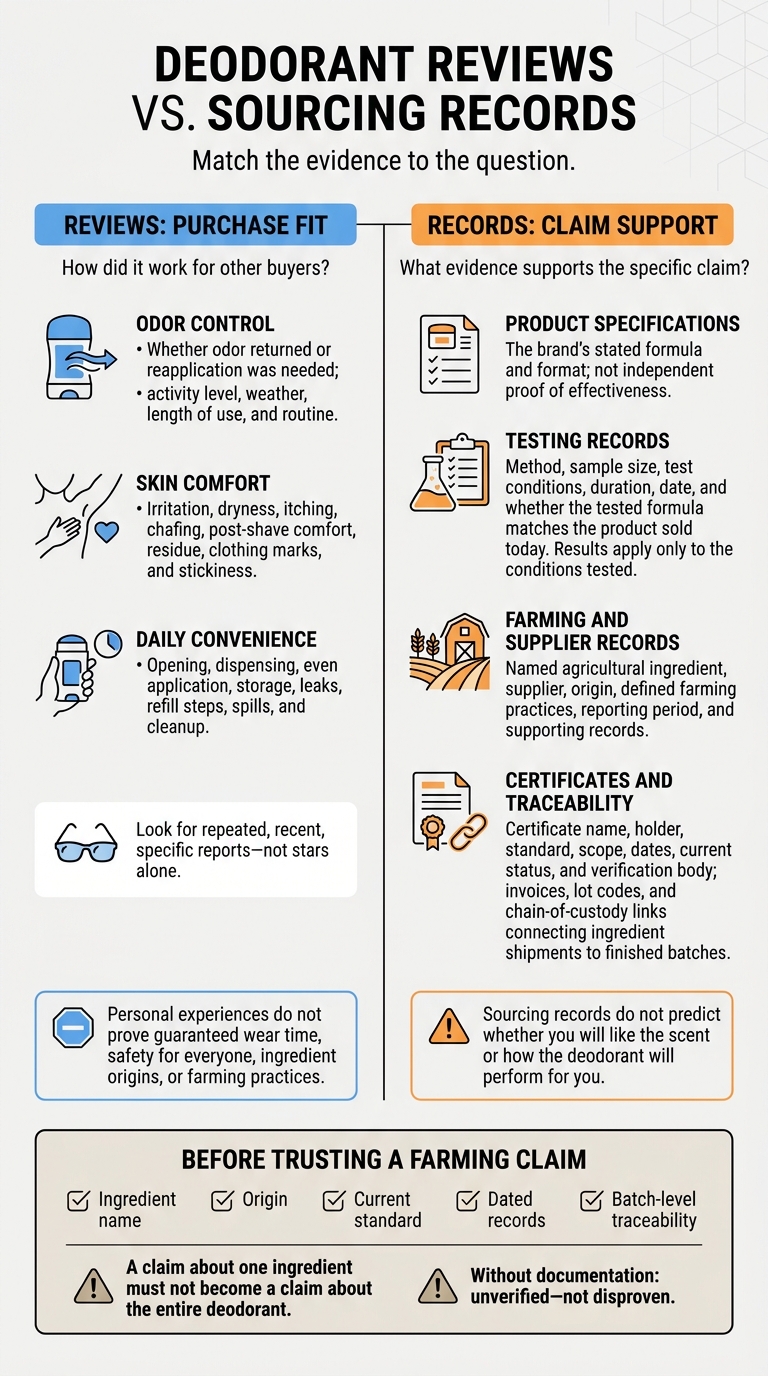
Deodorant Reviews vs. Sourcing Records
1. What Buyer Reviews Can Tell You
Elemental’s reviews can help you judge whether its deodorant fits your routine - but the average rating is only a starting point. Check review volume, dates, product options, and positive and negative feedback. Verified-purchase labels, disclosure notes, and repeated, detailed reports offer clues, not proof.
Odor Control During Workdays and Exercise
Look for reviews that describe activity level, weather, length of use, and routine. Reports about commuting, workdays, or exercise are most useful when they say whether odor returned or reapplication was needed. Silence about reapplication doesn’t mean it wasn’t needed. Neither silence nor reported odor control proves a guaranteed wear time or reduced sweating.
Skin Comfort, Residue, and Scent
Look beyond “gentle” for repeated reports about irritation, dryness, itching, chafing, or post-shave comfort. Check how long each reviewer used the product.
Keep odor control separate from how the product feels. Residue, clothing marks, stickiness, and scent can each affect satisfaction. Scent preference isn’t a measure of performance.
Application and Refill Convenience
Reviews can help you judge daily use, too. For bottles, check comments on opening, dispensing, even application, storage, and leaks. For refills, look for details about the steps, spills, and cleanup.
In September 2023, Riley F. described keeping the original Elemental bottle and emptying a liquid packet into it, and said the refill process felt straightforward.[1] That is one buyer’s experience.
Check for order and subscription problems as well: late or damaged deliveries, difficulty changing timing or skipping shipments, and trouble getting support. Give more weight to repeated, recent reports, and note whether the issues were resolved. Before subscribing, check the current terms directly; older reviews aren’t promises.
For farming and sourcing claims, use brand and supplier records rather than buyer feedback.
sbb-itb-18dae44
2. What Brand and Supplier Records Can Tell You
Reviews tell you how a deodorant worked for someone else. Brand and supplier records help you check what was sold, tested, and sourced before you buy.
Product Specifications: What Is Being Sold?
Product specifications describe the brand’s stated formula and format - not independent proof that it works. Check the current pages for NUR scented deodorant, Air fragrance-free deodorant, refills, and subscriptions. Look for formula and format details, refill instructions, delivery schedules, and cancellation terms.
Record the page title, access date, and product variant. Then compare those details with your bottle or refill label. If they differ, keep both versions and ask Elemental to explain.
A product description cannot establish where an agricultural ingredient was grown or how it was farmed. Those claims need support from sourcing documents; claims about the formula’s performance need testing records.
Testing Records: What Was Measured?
For tests of odor control, skin tolerability, stability, or packaging integrity, ask for the method, sample size, test conditions, duration, and date. Also ask whether the tested formula matches the product sold today.
Results apply only to the conditions tested. They do not guarantee how the deodorant will work for you. Use safety records to assess tolerability and stability - not wear time. For ingredient origins or farming claims, check supplier and farm records instead.
Farming Records: How Was the Ingredient Produced?
To check a farming claim, ask for the named agricultural ingredient, its supplier and origin, and records supporting the specific farming practice described. Lot records should connect that material to the finished deodorant.
An ingredient list tells you what is in the formula. It does not verify cultivation methods or regenerative practices. If a farming claim affects your purchase decision, ask Elemental for the records behind it.
What Records Support Farming Claims?
Buyer reviews can help you judge odor control, skin comfort, and ease of use. Farming and sourcing claims need records, not customer feedback. Use this table to tell the difference when choosing a deodorant.
| Category | What buyer reviews can indicate | What reviews cannot verify | What records should show | Confidence level |
|---|---|---|---|---|
| Odor control | Reported odor reduction, how long it lasts in daily routines, and differences between users | A standardized protection period, laboratory result, or outcome for everyone | Current formula and batch records | A guide to performance, not proof |
| Skin comfort | Reports of stinging, dryness, residue, or tolerance | Safety for every user, medical suitability, or no risk of irritation | Full ingredient and allergen information, manufacturing controls, and complaint monitoring | A guide; results depend on the user |
| Application convenience | Ease of application, drying time, packaging usability, and refilling | Packaging specifications, waste totals, or compatibility with every refill | Packaging specifications, refill instructions, production records, and waste data | A guide to usability |
| Ingredient origin | Customer reports about disclosed origins | Where an ingredient was grown or who produced it | Ingredient name, country or region, and farm, producer, or cooperative identity | Low unless records are current and specific |
| Regenerative practices | Whether customers find the explanation believable or clear | Soil improvement, biodiversity outcomes, input restrictions, or land-management practices | Defined practice criteria, farm records, monitoring data, and independent verification where applicable | Only as strong as the evidence for that claim |
| Ethical labor | Views on transparency and reported concerns | Worker pay, hours, forced-labor safeguards, or grievance outcomes | Supplier code, worker-welfare audits, contracts, corrective actions, and certification scope | Depends on current labor records |
| Certification | Whether buyers recognize or discuss a label | Certificate validity, holder, coverage, or audit result | Certificate name, holder, standard, scope, dates, and verification body | High only when scope and status are current and verifiable |
| Traceability | Whether customers report clear batch information | How the claimed ingredient reached the finished deodorant bottle | Invoices, lot codes, and chain-of-custody links from ingredient shipment to finished bottle | Depends on supporting records |
Identify the Ingredient, Origin, and Farming Practices
Ask which ingredient the claim covers, where it comes from, and which farm, producer, or cooperative supplies it. Request a plain-language definition of “regenerative” or “ethical,” including the practices measured and the reporting period. A claim about one ingredient must not become a claim about the entire deodorant.
Check Certification Scope and Dates
Request the certification name, holder, standard, scope, effective dates, current status, and audit or verification body. Check that it covers the ingredient and production period in question.
A processor’s certificate does not automatically prove farm practices. Where claims cover worker welfare, land management, soil practices, biodiversity, or input controls, request evidence for each. A narrow certificate cannot support broader claims.
Trace the Ingredient to the Finished Product
Request invoices, bills of lading, supplier certificates, receiving records, and production lot codes that link the ingredient shipment to the deodorant batch.
Ask which custody model applies. Identity preservation keeps a specific source identifiable. Segregation keeps qualifying material separate from nonqualifying material but may combine qualifying sources. Mass balance tracks qualifying input and output quantities while allowing mixing. Mass-balance records do not necessarily prove that the claimed material is physically present in your bottle.
Strengths and Limits of Each Evidence Source
Match the evidence to the question you’re asking. Reviews can help you judge odor control and refill ease, but they don’t verify farming practices. Sourcing certificates can support a sourcing claim, but they won’t tell you whether you’ll like a scent.
| Evidence source | Advantages | Limitations | Best use |
|---|---|---|---|
| Buyer reviews | Describe odor control, comfort, residue, scent, and refill ease during daily use. | Experiences vary; feedback may be selective or sponsored. | Look for repeated experiences from people with routines like yours. |
| Brand statements | Explain product features and how the brand defines its claims. | State claims rather than verify them. | Identify claims that need supporting evidence. |
| Supplier declarations and farming records | Can identify ingredient sources and documented practices. | May be outdated, incomplete, or lack independent checks. | Check a specific sourcing claim. |
| Certificates and audit reports | Support compliance with a named standard. | Prove only what falls within their scope; don’t predict wear performance. | Compare the claim with what the certificate covers. |
| Transaction and chain-of-custody records | Link ingredient shipments to finished batches. | Don’t establish cultivation methods on their own. | Connect sourcing evidence to the finished product. |
| Packaging and refill documentation | Support documented material and reuse claims. | Don’t establish farming practices or total lifecycle waste. | Check packaging claims separately from sourcing claims. |
When choosing deodorant, read beyond the star average. Check whether reviewers received an incentive, and look for positive and negative feedback about application, comfort, and refilling. A “verified purchase” label doesn’t turn personal feedback into controlled testing.
Packaging records answer a different question from farming records. Documentation of a refillable bottle can support packaging claims, not claims about how ingredients were grown.
If sourcing records aren’t available, describe the farming claim as not independently verified, not proven false. For your purchase decision, focus on reviews that describe wear and refill convenience under conditions similar to your own.
Conclusion: Use Reviews for Experience and Records for Sourcing
Start by reading Elemental buyer reviews to assess odor control, skin comfort, and refill convenience. Give more weight to repeated, specific experiences than to star averages.
Reviews help you judge purchase fit; records support sourcing claims. For any farming claim, ask for the ingredient name, origin, current standard, dated records, and batch-level traceability. Check what the certificate covers, not just its name. Without documentation, treat the claim as unverified - not disproven.
FAQs
How should I weigh conflicting Elemental Deodorant reviews?
Read reviews from people whose skin sensitivity, activity level, and climate match yours. Look for details about all-day odor control and skin comfort, not just star ratings.
Body chemistry varies, so positive reviews don’t guarantee that a deodorant will work for you. Use that feedback to narrow your choices, then try the formula to see how it suits your skin history and daily routine.
Which sourcing documents should I request first?
Ask for harvest records, processing certifications, and official audit reports that document chain of custody, ethical labor practices, and environmental standards. Request ingredient origins for the current lot, rather than general sourcing statements. A brand may use both organic and non-organic lots.
For Elemental Deodorant, check the product label for the exact ingredients in the bottle or refill you receive. The label provides ingredient information; it does not verify agricultural practices.
What if sourcing records don’t match my batch?
Ingredient sourcing can vary by lot, so general sourcing claims or records may not match your batch. Check the label on your bottle or refill for its exact ingredients. It’s the most accurate source for the formula you received.