


Quick Answers
- Large reviews and major health organizations have generally found no compelling evidence linking aluminum-based antiperspirants to increased cancer risk, though the estrogen-receptor concern persists online.
- For most users, underarm irritation from aluminum appears to be local and tied to duct-plugging in occluded skin rather than meaningful absorption into the bloodstream.
- Fragrances and preservatives, including natural essential oils like lavender and tea tree, are common triggers for allergic contact dermatitis from deodorants.
- Magnesium hydroxide is intended to neutralize acidic odor compounds and shift skin pH without blocking sweat glands, which may help avoid interfering with normal sweating.
- Some product testers report that magnesium-based formulas can deliver all-day odor control with less chalky residue, but individual results vary.
Why Aluminum‑Free Deodorants Matter
Three forces are converging right now. Athletes with sensitive skin want serious odor control without irritation. Eco-conscious consumers won't tolerate single-use plastic waste. And dermatologists are flagging ingredients that traditional formulas treated as harmless for decades.

Underarm skin sits in a microenvironment defined by humidity, occlusion, and constant friction. That makes it uniquely reactive to ingredients that would behave fine on your forearm. When you layer in the reapplication demands of high-intensity training, you're exposing your skin to multiple daily doses of fragrance allergens and preservatives in conditions that can amplify their reactivity.
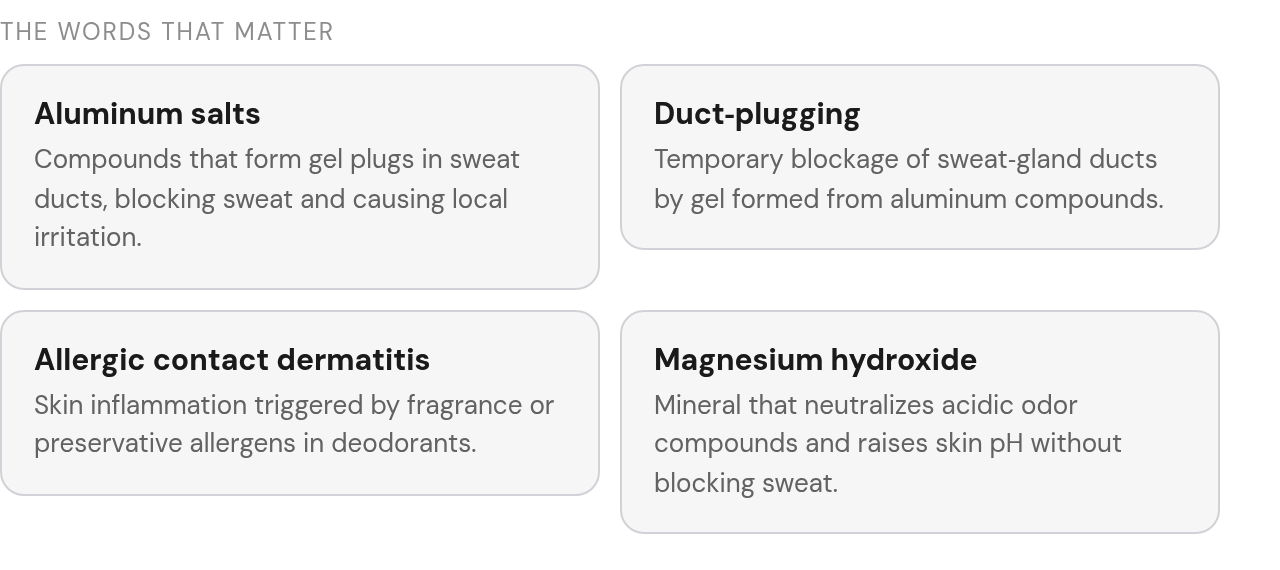
Aluminum Salts: Local Irritation, Not a Systemic Problem
Aluminum compounds block sweat ducts temporarily by forming gel plugs in the gland openings. That's how many antiperspirants keep you dry. The cancer concern often traces back to a persistent anecdote: if aluminum were absorbed through the skin, could it interfere with estrogen receptors in breast tissue?
Large reviews have generally not supported that fear. The more relevant issue for daily users is irritation at the application site. Some dermatologists report seeing contact dermatitis cases regularly, especially when people apply antiperspirant to freshly shaved skin or right after showering. The irritation may be manageable through application timing and formulation adjustments, but for sensitive-skin athletes who shave and shower often, it can become a recurring problem.
The Real Sensitizers: Fragrances and Preservatives
Fragrances are a common driver of allergic contact dermatitis from deodorants. That includes essential oils. The assumption that natural-origin fragrances are gentler than synthetic ones is not automatically supported by patch testing. Lavender oil, tea tree oil, and citrus extracts can trigger reactions in sensitized individuals.
Preservatives can be another irritant class. These compounds help prevent microbial growth in cream and gel formulas, but they can be potent allergens for some people.
For athletes, the risk may compound. High-occlusion conditions from exercise can amplify the reactivity of ingredients such as some humectants and surfactants that many consumers tolerate fine. If you're reapplying deodorant after a morning gym session and again after training later in the day, you're giving reactive underarm skin more opportunities to flare.
Magnesium Hydroxide: Non-Occlusive Odor Control
Magnesium hydroxide neutralizes the acidic compounds produced when skin bacteria break down sweat. It shifts skin pH without blocking your sweat glands. Users who couldn't tolerate aluminum salts or baking soda often describe favorable tolerability with magnesium formulas formulas.
The mechanism matters for athletes. You still sweat normally, which is what your body needs during temperature regulation under load. The magnesium compound is designed to intercept odor-causing breakdown products before they volatilize. This approach avoids the trapped-sweat feeling some users associate with aluminum antiperspirants.
Anecdotal product testing also points in the same direction: magnesium-based formulas may hold up through normal daily use, workouts, and repeat application while keeping texture smooth enough for people who dislike gritty or chalky sticks.
Why Refillable Systems Solve the Experimentation Problem
Finding the right aluminum-free formula often requires trial. Some users tolerate charcoal-based products but react to acid-based gels. Others need fragrance-free magnesium formulas to avoid essential oil sensitivity. That testing window can translate to multiple purchases if you're experimenting across brands.
Single-use packaging makes ethical iteration feel wasteful. A refillable subscription model lets you test magnesium versus charcoal versus probiotic blends without multiplying landfill waste. You're swapping refills, not throwing away entire containers. For eco-conscious athletes, that removes some of the guilt barrier that can keep people locked into a formula that's "good enough" rather than genuinely right for their skin.
Transparency around what's in the formula plus a delivery system that doesn't penalize experimentation can create conditions for users to find their match without compromising on either performance or environmental impact.
Aluminum vs. Skin: What the Science Says
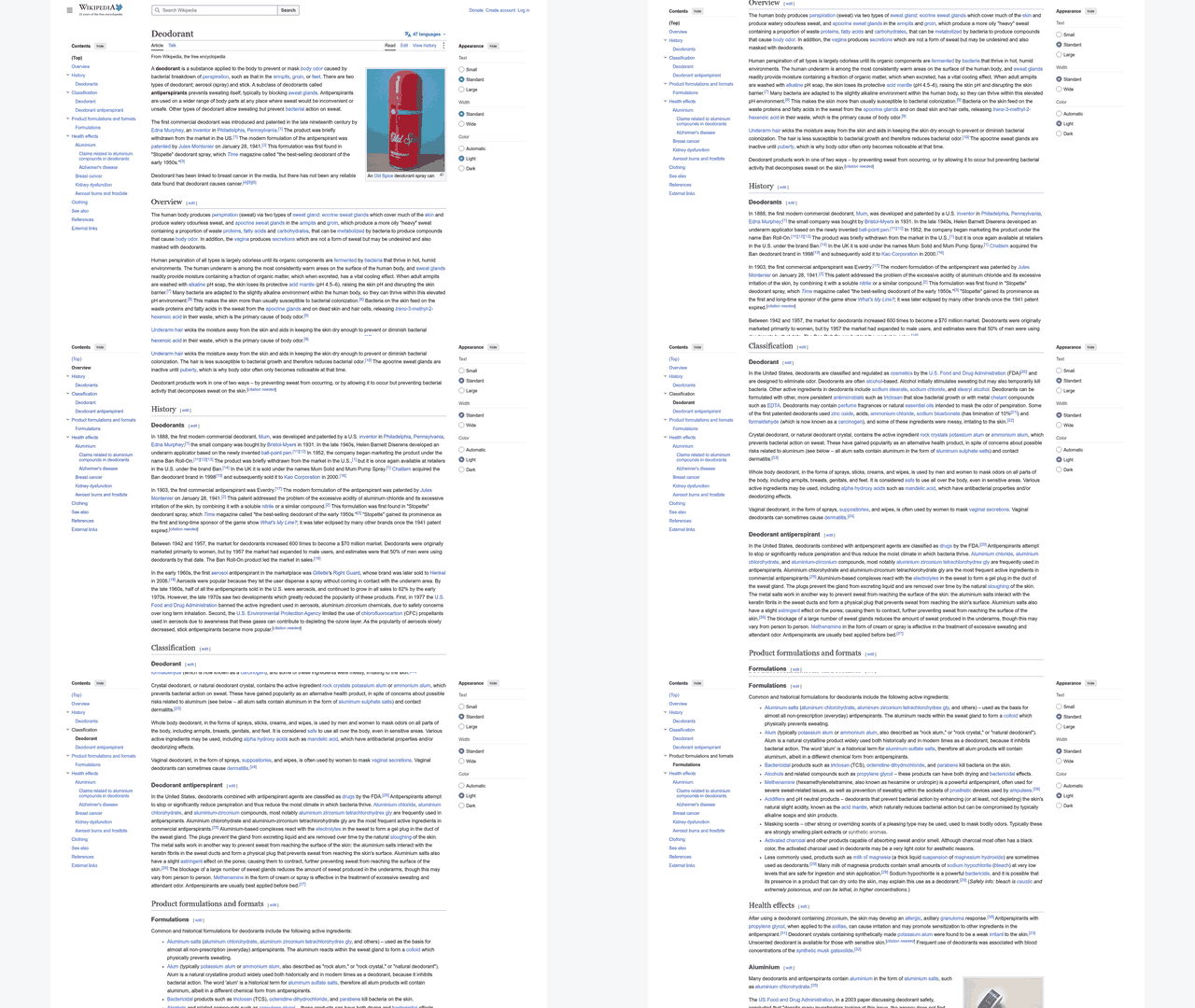
The mechanism is more specific than most brand copy makes it sound. Aluminum salt doesn't merely sit on your skin. It dissolves in sweat at the surface of the gland, then forms a temporary plug inside the duct. That plug is what cuts sweat flow. It is also the ingredient category most closely associated with regulated sweat-reduction claims, which is why antiperspirants are regulated differently from deodorants.
So where does the irritation come from? For most users, not usually from aluminum crossing into the bloodstream. The trouble is local: duct-blocking in a warm, high-friction fold can irritate reactive skin, especially when shaving, sweat, and repeated application are part of the routine.
Aluminum's Problem Is Local, Not Systemic
For most users, the honest read on aluminum is narrow. It works, and the systemic health panic around it is not where the best evidence points. But it can still be the wrong fit for someone whose underarms sting, itch, or inflame every time sweat ducts are blocked.
That distinction matters. If conventional antiperspirant bothers you, the reaction is real even if the internet's bigger health claims are overstated. Switching to aluminum-free deodorant is less about fear and more about choosing a mechanism your skin tolerates.
Magnesium Hydroxide Skips the Plug Entirely
This is the chemistry that matters for athletes. Magnesium hydroxide doesn't block anything. It neutralizes the volatile fatty acids that skin bacteria produce, and it nudges the surface environment so odor-producing bacteria may struggle. Your sweat still flows. Your body still cools itself.
That non-occlusive approach is why it tends to sit well on some reactive skin. No plug means no duct pressure. For a cyclist applying before a hot commute, that can be the difference between comfortable underarms and irritation that builds all day.
"Natural" Doesn't Mean Hypoallergenic
The trap is assuming a green label equals a calmer formula. Often the biggest sensitizers in many deodorants, aluminum-free included, are fragrances and certain preservatives, not the active mineral. A "botanical" claim does not cancel out the possibility of irritation.
For sensitive-skin athletes, a short magnesium hydroxide formula may beat a heavily scented natural one. Skip any aluminum-free stick loaded with baking soda if your skin already runs hot and reactive. NUR skips baking soda entirely and keeps its scent, Desert Rain, light and built from organic essential oils. Essential oils can still trigger reactions in some people, so if you already know fragrance is a trigger, a scented formula may not be your safest first test.
Now the practical bind: finding your formula takes trial. Some reviewers work through multiple products in real gym-and-work conditions before deciding what holds up. Iterating through that many sticks in single-use plastic is exactly the waste eco-conscious athletes want to avoid.
A refillable subscription helps with that math. NUR lives in a refillable glass bottle you top up with a biodegradable pouch, refilling the same vessel instead of tossing plastic each round. And switching is a low-stakes experiment: keep your usual deodorant on hand while you test how magnesium-powered odor control works for you. Safe skin, controlled odor, no landfill penalty for experimenting. If you want the deeper ingredient breakdown, our guide on natural versus chemical deodorants walks through what to look for on a label.
The Quick Verdict on Aluminum‑Free Deodorants
Aluminum-free deodorant kills odor but won't stop you sweating. That's the trade you're making. A natural formula will keep you fresh without keeping you dry. For eco-conscious athletes who care more about skin comfort and single-use waste than a bone-dry pit, that trade is usually worth it.
The bigger buying mistake is choosing by claims instead of skin compatibility. A cleaner-looking label can still hide ingredients that reactive underarms hate. A better starting point is a baking-soda-free formula built around magnesium hydroxide, with scent kept minimal or removed entirely if you know fragrance bothers you.
Is Aluminum-Free Deodorant Right for You?
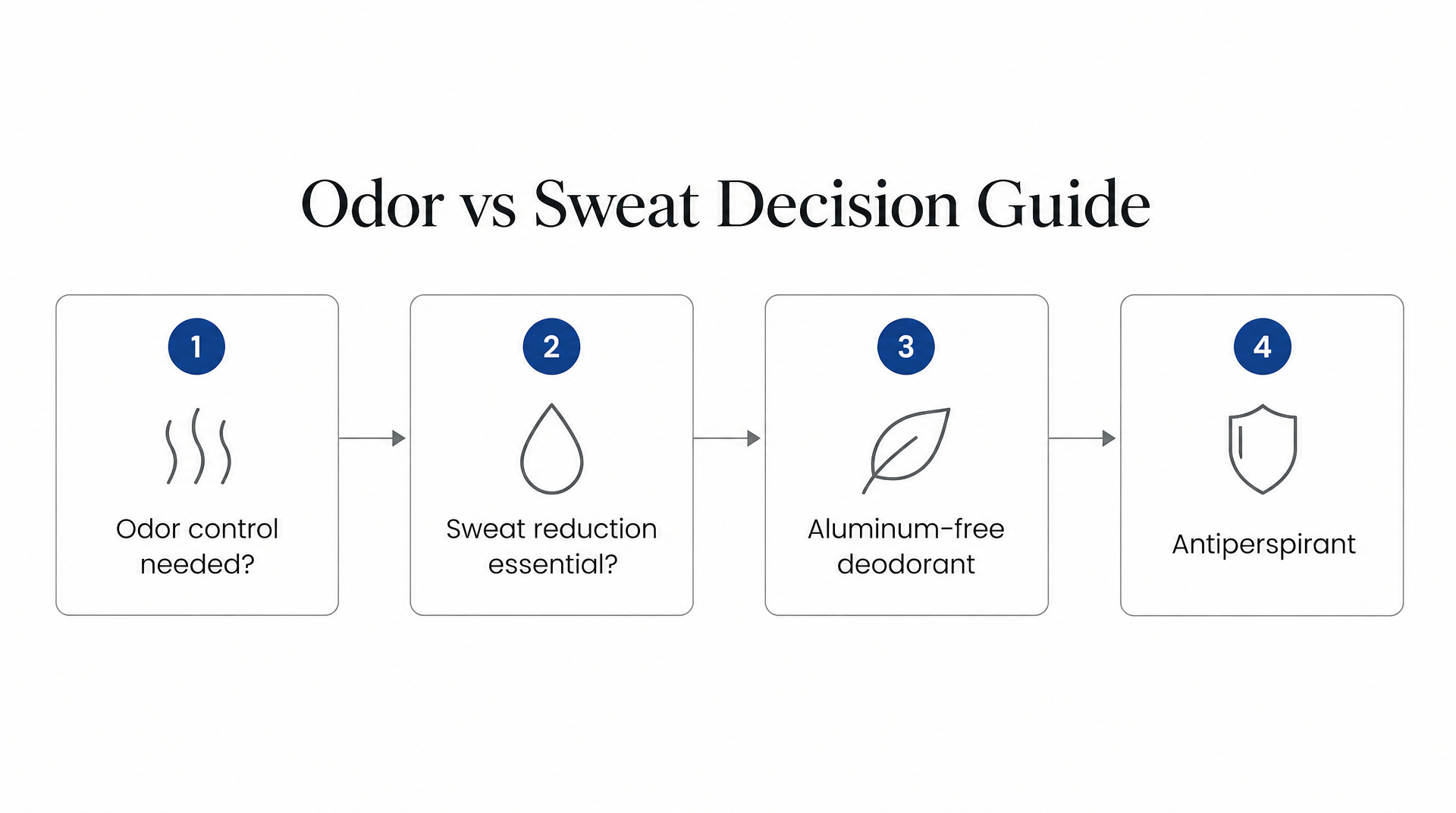
Choose aluminum-free if your priority is odor control, sensitive-skin comfort, and cutting plastic waste. Skip it if you genuinely sweat through your clothes and need that stopped. In that case an antiperspirant does a job a deodorant can't, and no amount of arrowroot powder will change the physics.
Try a natural deodorant that actually works
Experience 24-hour odor protection with Elemental Deodorant. Made with organic ingredients, it's aluminum-free, vegan, and eco-friendly. Gentle on your skin and the planet.
Shop ElementalA deodorant handles odor, not wetness. Arrowroot powder can absorb some moisture at the surface, but it does not shut down sweat flow. Expect to reapply after a hard session. That's normal, not a product failure.
Give your skin a fair test before deciding. Underarms that have been used to antiperspirant may need time to adjust to a formula that controls smell without creating a dry barrier.
Which Aluminum-Free Formula Should Athletes Pick?
For high-sweat, sensitive skin, go simple: magnesium hydroxide, no baking soda, and fragrance-free if you already know scent is a trigger. Athletes face a double irritation risk because training traps heat and moisture under the arm, while frequent reapplication keeps adding whatever potential allergens are in the product.
You're not just dodging one ingredient. You're choosing a formula that avoids the fragrance and preservative overload behind many deodorant reactions. If you want the deeper breakdown, our guide on natural vs chemical deodorants walks through the differences.
How Does a Refillable System Save Money and Waste?
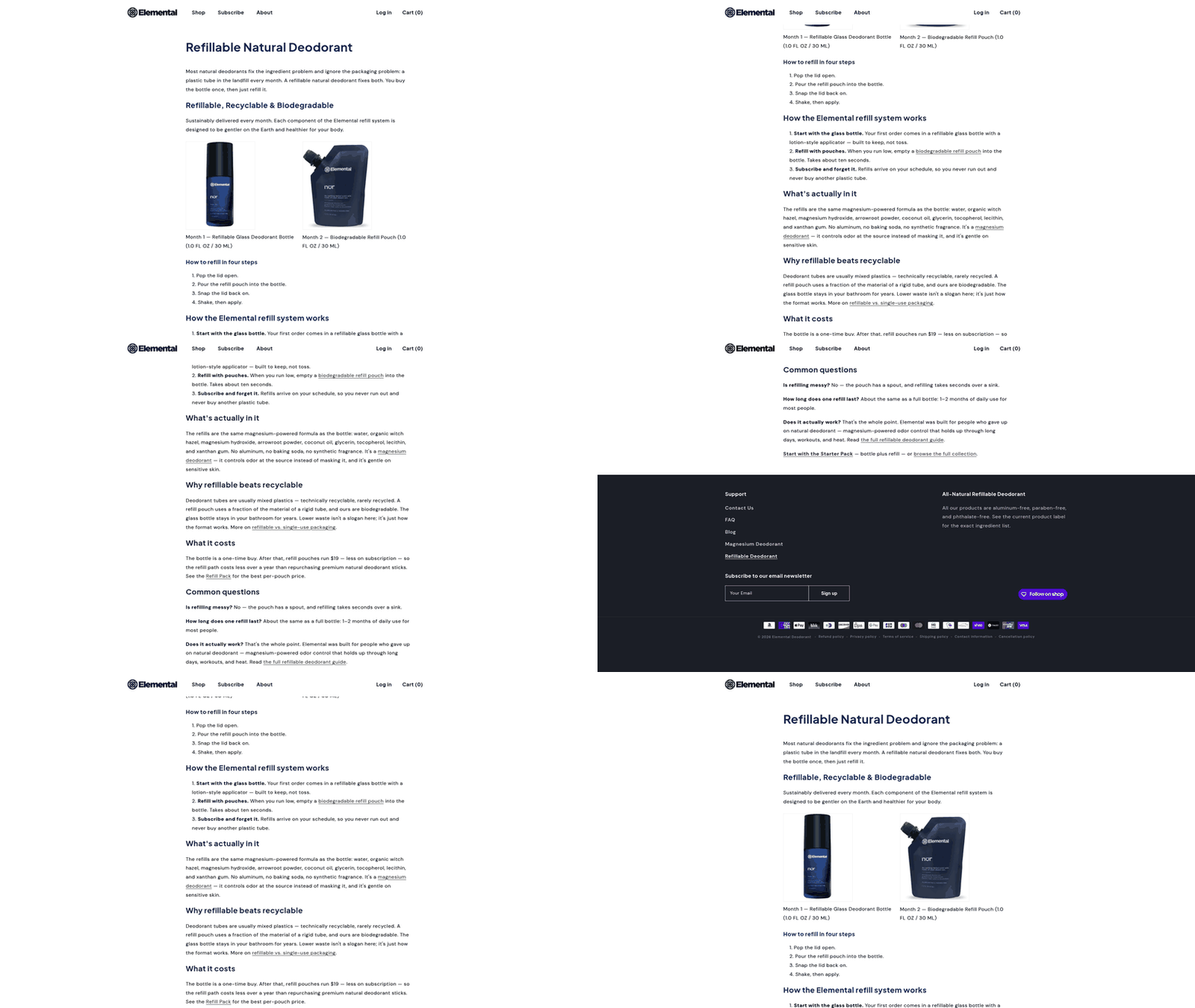
A full glass bottle of NUR is $21, or $15.75 a month on subscription, and refills keep the longer-term cost down. You keep the bottle and swap only a biodegradable refill pouch. About ten seconds of work. Budget aluminum-free sticks exist too, but many lock you into throwaway packaging every few weeks.
That refill math is easier to judge as a monthly cost than a price-per-gram comparison. For example, if a refill lasts two months, the subscription works out to about $7.88 per month; if you finish one in a month, it is $15.75. That may not beat the cheapest stick on the shelf, but it changes the packaging tradeoff.
Sensitive skin often forces trial and error, and every failed single-use stick becomes part of the cost of figuring out what your skin can handle. A refill model lets you be picky about your skin and your footprint at the same time. It doesn't eliminate packaging or shipping, but it removes the need to throw away a container with every formula change. For an athlete who reapplies daily and cares where the container ends up, that's the version of aluminum-free that may actually hold up over a season.
Magnesium‑Powered Odor Control: The Mechanism Explained
Body odor isn't the sweat itself. Fresh sweat is nearly odorless. The smell shows up when bacteria on your skin, mostly Corynebacterium and Staphylococcus species, break down the proteins and fats in apocrine sweat into volatile fatty acids. Those acids are what you notice after a hard session.
That's why magnesium hydroxide works without touching your sweat glands. It doesn't cut moisture the way an antiperspirant does. It changes the chemistry that turns sweat into odor.
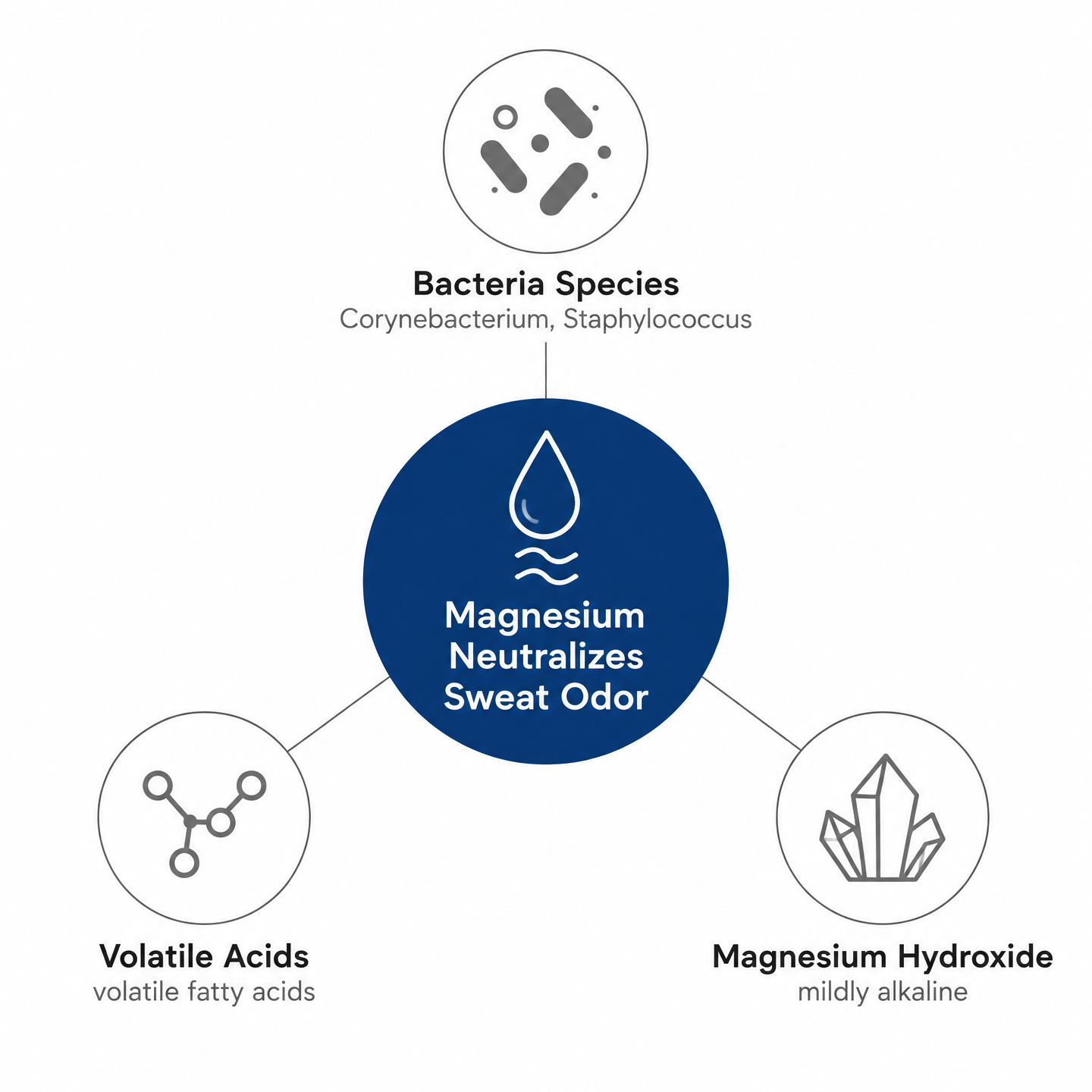
Magnesium Shifts The pH That Bacteria Need To Thrive
Odor-producing bacteria tend to prefer a slightly acidic skin surface. Magnesium hydroxide is mildly alkaline, so it raises the pH enough to interfere with the enzymatic pathways those microbes use to break sweat apart. Less enzymatic activity can mean less odor.
The advantage is that magnesium works at the source instead of relying on perfume layered over stink. That matters when you train, commute, or work long shifts, because scent alone rarely survives heat and sweat gracefully.
For an athlete, the priority is balance: handle odor while letting the body cool itself normally. Magnesium fits that brief because it targets smell chemistry rather than sweat production.
Fragrance-Free Is The Safer Bet For Reactive Underarms
If your underarms flare easily, don't let scent carry the formula. Magnesium hydroxide can work in both scented and fragrance-free products, so fragrance-sensitive users can still get odor control without adding a common trigger.
That flexibility is useful because people react differently. Some can tolerate a light scent without issue. Others do better when the active mineral does the work alone. If you are eczema-prone, freshly shaved, or already irritated, fragrance-free is the safer first test.
Magnesium is a mineral your body already carries. At the concentrations used in cosmetics, topical use is generally considered safe for intact skin, which is part of why aluminum-free formulas suit people who prefer to skip aluminum. No duct plugging, no sweat suppression, no systemic worry.

Clean, Dry Skin Makes It Last Longer
Magnesium binds best to a clean, dry surface. Apply straight after a shower, once your skin has dried, so the active sits directly on the skin instead of on top of leftover sweat or old product. That one habit may stretch how long each application holds.
Be patient through the early switch. A natural deodorant routine can feel different at first because it is not trying to create the same dry, blocked sensation as an antiperspirant.
A refillable model earns its place here. Honest experimentation takes enough product to learn what actually works on your skin during workouts, workdays, and heat. Iterating through magnesium, charcoal, and acid-based options shouldn't mean a pile of tossed plastic. A refillable subscription lets eco-conscious athletes test and switch formulas without multiplying single-use waste every time they refine their routine.
Choosing the Right Aluminum‑Free Deodorant for Sensitive Skin
Picking an aluminum-free deodorant for sensitive skin isn't a vibe check. It's a short list of yes/no calls you can make standing in the aisle or scrolling a product page. Get the ingredient read right and you may skip weeks of trial-and-error stinging.
No label can fully predict your skin. A formula can be clean, popular, and well reviewed and still bother you. Use the ingredient list to narrow the field, then test methodically instead of buying every promising stick you see.
Read the Ingredient List Before Anything Else
Start at the label, not the marketing. You want magnesium hydroxide as the active. It neutralizes odor by shifting skin pH without occluding your sweat ducts, and some dermatology literature describes it as a promising, well-tolerated alternative for exactly this reason.
Then scan for what to avoid. Baking soda tops the list for some sensitive underarms because its high pH can burn. Heavy fragrance oils are next. And skip anything still carrying aluminum chlorohydrate if your goal is a non-blocking formula.
A second pass through the ingredient list helps if your skin is especially reactive. Shorter formulas give you fewer suspects if irritation shows up. If you see a long list of scent components, plant extracts, and preservatives, treat that as more complexity for your skin to manage rather than proof the product is better.
Athletes Carry a Compound Irritation Risk
Exercise changes the math. Occlusion from tight gear plus heat can ramp up the reactivity of ingredients that may seem mild on paper. Then you reapply after a hard session, giving your skin another exposure while it is already warm and damp.
That's the case for a fragrance-free, baking-soda-free, magnesium-based formula if you train hard. It addresses both problems at once: no sweat-duct blocking and fewer avoidable triggers. A charcoal-and-magnesium formula may also work well for some users, as long as you remember the trade: odor control does not mean sweat elimination.
Patch-Test, Then Let Packaging Settle the Tie
Before committing, patch-test. Rub a pea-sized amount on your inner forearm and leave it 48 hours. No redness, no itch means you're clear to move it to your underarms. It's a two-day insurance policy against a week of discomfort.
If finding your match takes several tries, single-use plastic tubes turn ethical experimenting into a pile of landfill waste. Refillable glass bottles with biodegradable refill pouches let you iterate through formulas without that guilt.
Two more label details reward a second look. Check the total ingredient count. Shorter formulas give reactive skin fewer suspects to react to, which speeds up figuring out what triggered a flare. And note the base: shea butter and coconut oil soothe, but coconut oil clogs some people's pores, so a formula built on lighter carriers can be the safer first test. For a commuter who bikes before a shift, a magnesium formula that holds through sweat can be the practical win.
Match the formula to your skin. Test before you trust it. Then pick packaging that lets you keep experimenting without the waste.
FAQ
Does aluminum-free deodorant stop you from sweating?
No. Aluminum-free deodorant is designed for odor control, not sweat reduction. If your main goal is to stay completely dry, you need an antiperspirant rather than a deodorant.
Why do some natural deodorants sting even though they're aluminum-free?
Aluminum-free does not automatically mean irritation-free. Stinging often comes from ingredients added for odor control, texture, preservation, or scent. If your skin reacts easily, start with a simple magnesium-based formula and avoid baking soda-heavy or heavily scented options.
How long does the adjustment period last when switching from antiperspirant?
Give the switch time before judging the result. The first stretch can feel different because your underarms are no longer being kept dry by a duct-blocking product. Applying to clean, dry skin helps the new formula perform more consistently.
Can I use aluminum-free deodorant if I sweat through my clothes?
You can use it for smell, but it will not solve heavy wetness. If sweat marks are the problem you most need fixed, aluminum-free deodorant may not be enough on its own.
Why does a refillable system matter for sensitive skin specifically?
Sensitive skin often takes experimentation. A refillable glass bottle with biodegradable refill pouches lets you keep testing what your underarms tolerate without turning every failed formula into another discarded plastic container.